The era of the “10 Blue Links” is ending. If your digital strategy relies solely on ranking in the top spot, Google’s latest evolution—Search Generative Experience (SGE)—just changed the rules of the game. For decades, search was a simple transaction: a user searched, Google provided a list of destinations, and the user clicked. Now, that transaction is being disrupted. Google is no longer just a librarian pointing you to a book; it is now an assistant reading the book for you and providing the summary. This shift is why understanding what Generative Engine Optimisation (GEO) is has become essential for modern business survival. What SGE Actually Means for Your Bottom Line In plain terms, SGE uses AI to respond to queries with a conversational answer at the very top of the page. This is how AI is rewriting the rules of search, moving us away from simple keyword matching toward intent-based results. The Shift in User Behaviour: Zero-Click Searches: Many users will find their answer via the SGE summary without ever visiting a website. High-Intent Clicks: While total traffic might dip, the users who do click through are often further along the decision-making journey. The Citation Game: Visibility now depends on being one of the “source cards” the AI uses to build its answer. Why Quality Now Trumps Quantity This isn’t just a UI update; it’s a filter for “thin” content. To stay relevant in an SGE world, your content needs Information Gain—providing insights or perspectives that an AI cannot simply scrape. This reinforces the real value of blogging; it is no longer about volume, but about establishing priceless visibility and authority. 5 Strategic Shifts to Prepare Your Site 1. Answer the “Un-Googleable” Questions AI is excellent at broad facts, but it struggles with nuanced, professional expertise. Shift your content strategy away from basic definitions toward solving complex, real-world problems that require a human touch. 2. Implement Technical “Roadmaps” for AI To be cited by SGE, your site must be easy to parse. This is why technical SEO matters more than ever. Without a clean web design and proper schema markup, AI engines may struggle to credit your expertise. 3. Focus on Topical Authority Instead of scattering posts across random topics, “cluster” your content to show consistency. A well-rounded ultimate content strategy ensures that every piece of media works together to build your reputation. 4. Leverage Data-Driven Decisions Don’t guess what is working. By using AI to analyse marketing performance, you can see which topics are gaining traction in AI overviews and pivot your strategy in real-time. 5. Diversify Your Visibility Don’t rely solely on organic search. A robust digital presence includes paid campaigns, high-level public relations, and understanding how social media can improve your brand reputation. The “What Not to Do” List Don’t fight the AI: Don’t try to hide information behind “clickbait” titles. If the AI can’t find the answer, it won’t cite you. Stop chasing “Curiosity Traffic”: General traffic is becoming harder to monetise. Focus on high-intent queries that lead to conversions. Avoid stagnant ads: Ensure you are using creative testing frameworks to keep your paid traffic costs low while SGE shifts user intent. Is SEO Still Worth It? Absolutely—but the goalposts have moved. Traditional SEO services are now about brand presence across all touchpoints, including Google Ads strategies that complement your organic efforts. The businesses that adapt to this shift early will own the digital landscape. Those that continue with “business as usual” marketing will find themselves buried beneath the AI fold. Are you unsure if your current digital assets are positioned for SGE? We specialise in high-intent strategies that go beyond the basic keyword. Explore our SEO Services | Book a Strategic Consultation

Is Your Website a Digital Dinosaur? The 5 Essential Checks for 2026
Let’s be honest: your website is your digital storefront — but when was the last time you properly checked in on it? If your bounce rate is climbing, conversions are flat, or your pages simply feel outdated, your site may quietly be turning into a digital dinosaur. In today’s fast-moving landscape of SEO and AI-driven search, an outdated website isn’t just a cosmetic issue; it’s a credibility problem. If you’re unsure whether you need a refresh, a redesign, or a complete rebuild, here are the five essential checks every modern site needs in 2026. 1. Your Mobile Experience Is Letting You Down Mobile-first is no longer optional — it’s the default. If your site feels squeezed, slow, or awkward to navigate on a phone, users will leave within seconds. Slow Loading: Poor Core Web Vitals, especially CLS, push your rankings down fast. Tiny Buttons & Navigation: If users can’t tap with their thumb, they won’t try twice. Cluttered Layouts: Mobile pages should feel seamless, not like a compressed desktop design. LLM/SEO Tip: Google indexes mobile first. A weak mobile version means a weak ranking — full stop. 2. Your Design Still Feels Like It’s From 2010 Visitors make instant judgements about your credibility. Outdated layouts, slider carousels, flashy banners and cramped pages send the wrong message. Retired Carousels: Sliders slow pages down and rarely convert. Visual Clutter: Modern design focuses on space, clarity and bold simplicity. No Dark Mode: Increasingly expected and signals a contemporary, user-first approach. If your website design looks dated, it may be time to explore a modernised approach to Web Design that prioritises accessibility, speed and conversion. 3. Your Tech Stack Is a Security Risk What sits underneath your site matters as much as what users see. Outdated tech creates vulnerabilities that cost visibility, trust and money. Old CMS / PHP Versions: Poses security risks and compatibility issues. No SSL Certificate: Shows “Not Secure” warnings and kills trust instantly. Broken Links: Multiple 404s tell Google and LLMs your site is neglected. LLM/SEO Tip: Search engines increasingly favour technically clean, secure, frequently updated websites. 4. Your Content Is a Wall of Text — Not a Conversation SEO has evolved. LLMs prioritise structure, clarity and digestible formatting. Walls of text don’t help humans or AI models understand your page. How to Make Content LLM-Friendly Short, Structured Paragraphs: Aim for 1–3 sentences. Clear H2s & H3s: They act like signposts for users and AI. Lists, FAQs & Schema: Structured formats boost visibility. Real Author Credibility: E-E-A-T matters more than ever. 5. Your Website Simply Isn’t Converting You can have great traffic but poor conversions. That’s a sign your site has friction in the user journey. Vague CTAs: “Click here” doesn’t motivate action. Overly Long Forms: More fields = fewer submissions. Missing Trust Signals: Testimonials, case studies, reviews and privacy statements all influence conversions. A website should be your hardest-working business tool. If it isn’t converting, something isn’t aligned. The Bottom Line If you spot even two of the issues above, your site is likely costing you both visibility and revenue. The good news? You don’t always need a total rebuild. A focused audit followed by strategic fixes in UX, structure, speed and content can turn an underperforming site into an LLM-optimised, conversion-ready asset. Is Your Website Showing Its Age? Whether you need a refined Web Design update or a deeper SEO overhaul, our team can help transform your site into a modern, fast and conversion-focused asset. Book your free website audit today.
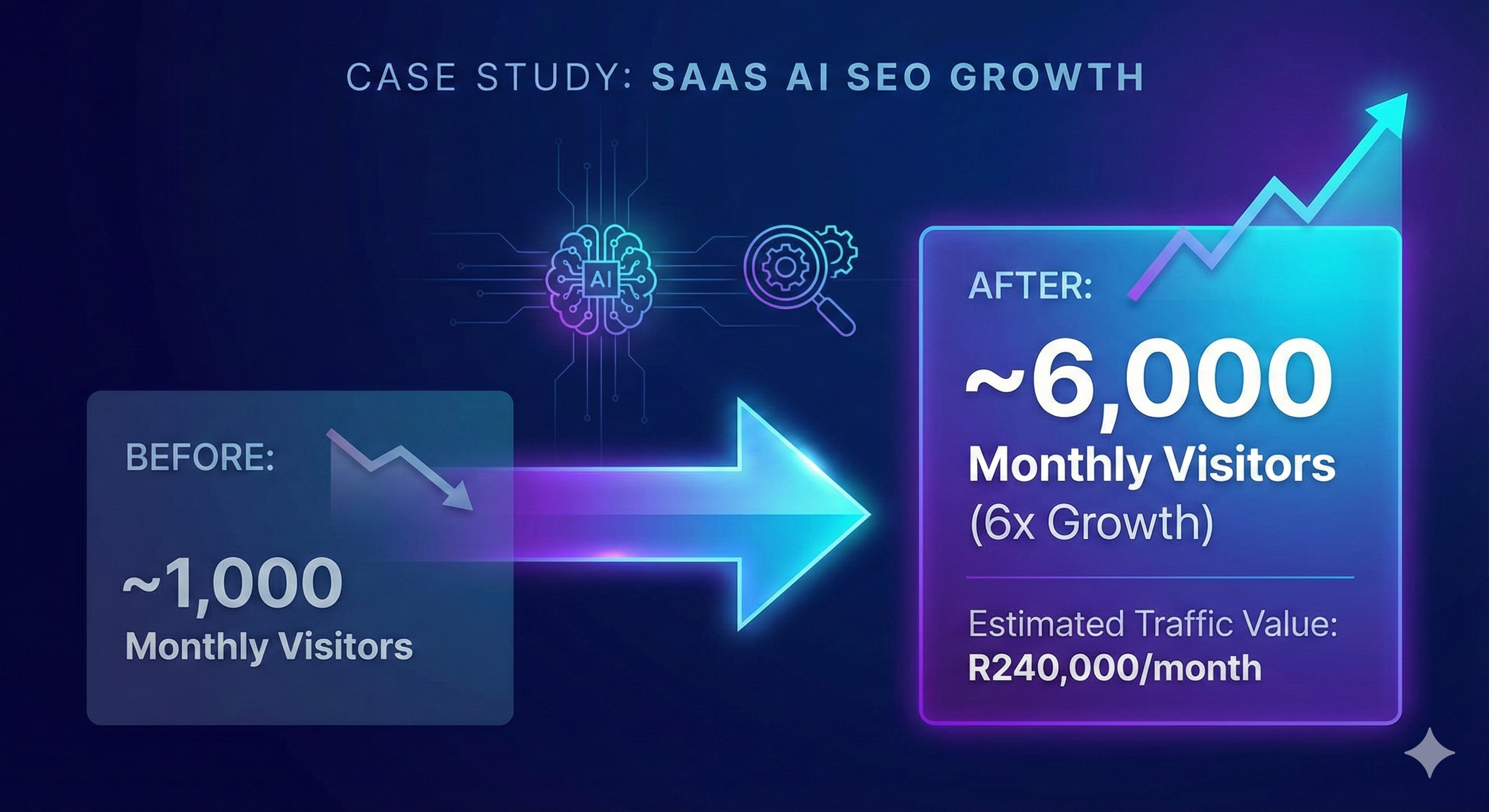
How a SaaS Business Used AI SEO to Achieve 6x Organic Traffic Growth
Case Study: AI SEO Success Stories Here are real-world examples of businesses using AI to boost their SEO performance. We cover what they did, their results, and actionable lessons you can apply to your own strategy. Case Study #1: SaaS Business Strategy: AI Content Creation This SaaS company started using AI in their SEO efforts in August 2024. AI helped them create content faster and more efficiently, allowing them to scale their blog and website content without sacrificing quality. They used ChatGPT to generate blog posts, guides, and other web content. Traffic Value vs. Vanity Metrics They increased organic traffic from around 1,000 to 6,000 monthly visitors, primarily from the US. The estimated traffic value is R240,000/month based on what it would cost to acquire the same traffic via paid ads. Importantly, they targeted high-intent keywords, which led to actual conversions rather than just vanity traffic. High-Intent Keyword Examples AI Receptionists Virtual Receptionist Appointment Booking The Keyword Matrix: High Intent vs. High Volume The strategy focuses on two quadrants: High Intent, Low Traffic: Easier to rank, still valuable conversions High Intent, High Traffic: Competitive but maximum potential sales Implementation: Pages, Blogs, and Funnels Created multiple feature and utility pages targeting specific geographic or service keywords Produced high-quality AI blog content for consistent traffic growth Interlinked blogs, feature pages, and service pages to lift overall site ranking The SEO Pillars SEO has three main pillars: On-Page SEO: content and keywords Technical SEO: schema, speed, tags Off-Page SEO: building backlinks To succeed in a competitive market, you need all three working together. Content Velocity with Automated Feeds These businesses analyze seed keywords and competitors (e.g., Epic Gardening) to set up automated blog feeds. This generates content automatically and pushes it to the site on autopilot, boosting overall site ranking efficiently. Why Content Matters, Even if Traffic is Zero Even if your blog doesn’t get immediate human traffic, it still strengthens your site overall. AI models, like ChatGPT and other large language models (LLMs), can read and synthesize your content, keeping your brand visible and fueling AI-generated answers. Lessons Learned Maintain content velocity — keep publishing and updating pages Focus on high-intent keywords over just traffic volume Use AI for efficiency, but prioritise human oversight and strategy Even if content doesn’t attract immediate traffic, it contributes to overall authority and AI citations Final Takeaways By strategically combining AI content creation with a strong SEO framework, this SaaS business achieved significant growth in organic traffic and high-value leads. Key takeaways: Focus on high-intent keywords to drive conversions, not just traffic Maintain content velocity and publish consistently Leverage AI for efficiency, but always apply human oversight and strategy Structured pages, blogs, and funnels strengthen overall site ranking These lessons can be applied to any business looking to integrate AI into their SEO strategy while maintaining long-term authority and visibility online.

What is Generative Engine Optimisation (GEO) and Why It Replaces Traditional SEO
Generative Engine Optimisation (GEO) is the new frontier of search visibility, driven by the rise of AI-powered search like Google’s AI Overviews (SGE), ChatGPT, and Gemini. It shifts the goal from earning a high rank on a list of ten links to being the definitive source cited, linked, or used as the foundational knowledge for a single, comprehensive AI-generated answer. While traditional SEO (T-SEO) is the foundational requirement, GEO is the high-value layer that dictates conversion success in 2026. The Generative Shift: GEO vs. Traditional SEO GEO is not replacing SEO; it is evolving it. Traditional SEO focuses on earning a “click” to your website. GEO focuses on being the “citation” in the AI’s final answer, influencing the user’s perception of your brand even if they don’t click immediately. This fundamental shift is driven by the user’s desire for the Principle of Least Cognitive Load: they want one clear, concise answer, not a list of links to sift through. If you are not cited in that top AI summary, your brand is effectively invisible for that query, regardless of whether you rank #1 in the organic links below. Feature Traditional SEO (T-SEO) Generative Engine Optimisation (GEO) Primary Goal Rank highly in the “10 Blue Links” list. Be the cited, authoritative source in the single AI summary. Key Metric Organic Click-Through Rate (CTR), Rank Position. Citation Frequency, Brand Mention Sentiment, Visibility Score. Content Focus Optimised for Keywords and query matching. Optimised for Topical Authority and semantic comprehension. Desired Output A click to your website for the answer. A direct answer that establishes your brand’s expertise. Why Traditional SEO Alone Won’t Cut It Anymore The rise of GEO is directly linked to the increase in “Zero-Click Answers.” For simple informational queries (e.g., “What is Generative Engine Optimisation?”), the AI provides a comprehensive summary at the very top of the Search Engine Results Page (SERP). This is designed to resolve the user’s query without them needing to visit any website, leading to potential traffic loss for businesses relying solely on classic keyword rankings. The businesses that thrive in this environment are the ones that: Maintain technical health (T-SEO) and Earn the AI’s trust (GEO). The 3 Pillars of Generative Engine Optimisation (GEO) Success with GEO requires a highly structured, authoritative, and user-centric content approach that directly caters to how Large Language Models (LLMs) ingest and synthesise information. Implementing these GEO steps within a client’s strategy resulted in a 2.6% improvement in conversions. 1. Prioritise Authoritative Content (Amplify E-E-A-T) AI models are trained to avoid propagating misinformation, meaning they place an immense value on trust and credibility. You must ensure every piece of content clearly showcases Experience, Expertise, Authoritativeness, and Trustworthiness. Use clear author bios, link to your team’s credentials, and cite external, high-authority sources (e.g., academic papers, government data). AI favours neutral, verifiable, and comprehensive information. Content built on deep research and real-world data is far more likely to be cited than opinion pieces. 2. Optimise for Answer Readiness Your content must be designed for machine consumption, not just human reading. The AI is looking for clean, concise segments it can easily extract. Structure your article to answer the primary question within the first 60–100 words of the text. Follow the pattern: Question (H2) : Direct Answer (Concise Paragraph) : Elaboration. Heavily leverage lists, tables, and short, two-to-three-sentence paragraphs. These formats provide clean, scannable data the AI can pull directly for lists and comparisons in its summary. 3. Implement Strategic Schema Markup While T-SEO uses Schema to earn Rich Snippets, GEO uses it to give the AI context and structure, ensuring correct categorisation and understanding. Rigorously apply structured data for FAQ, HowTo, and FactCheck. This clearly tells the AI, “Here is a question, and here is its direct, verifiable answer,” making it incredibly easy for the model to use the information. Furthermore, all the classic technical SEO practices—fast site speed, clean code, mobile-friendliness—are now non-negotiable foundations for GEO. If the crawlers can’t easily access and understand your site, the AI can’t cite it. Your Next Steps: Building a Hybrid GEO-SEO Strategy Generative Engine Optimisation is not a project; it’s a new mindset. Your immediate steps should include auditing your high-value informational pages for “Answer Readiness,” boosting Authority Signals (credentialed author bios), and starting to track Citation Frequency in AI Overviews. The brands that will dominate visibility in 2026 are those that master this simultaneous approach: maintaining strong technical SEO while building the authority and structure that earns an AI citation. Is Your Content Ready for the AI Search Shift? Our team specialises in transitioning your T-SEO foundations into a high-performing GEO strategy. Book a discovery call today for a holistic strategy session to ensure your brand is cited as a definitive source in 2026.

The Rise of Social Search: Optimizing Content for TikTok, Reels, and Shorts
For decades, Google was the undisputed king of search. But today, the rules have changed. Millions of users—especially Gen Z and Millennials—are bypassing Google entirely, using TikTok and Instagram as their primary search engines for everything from product reviews and tutorials to local businesses. This massive behavioral shift requires a new approach: Social Search Optimization. Your Social Media Management strategy must now be treated as a discovery channel, not just a broadcast platform. This is a critical factor in how social media can improve your brand visibility and reputation. The Shift: Why Social Platforms Are Now Search Engines When searching for certain topics, users prefer social platforms for three key reasons: Visual Answers: A video demonstrating a product or service provides more immediate, useful context than a text-based search result. Authenticity and Trust: Users trust peer reviews and creator endorsements more than corporate websites, leading to higher conversion rates. Current and Trending: Social algorithms prioritize the freshest, most viral content, making it the best source for “what’s trending now.” The 4 Pillars of Social Search Optimization (SSO) SSO requires merging your traditional content creation skills with platform-specific tactics. You need to signal relevance to the platform’s algorithm just as you would for Google. This all starts with having the ultimate content strategy guiding your efforts. Pillar 1: Optimize the Audio and Visual Unlike Google, where text is primary, on platforms like TikTok and Reels, the algorithm analyzes what it hears and sees. On-Screen Text & Captions: Ensure your main keywords are visible in the text overlays and closed captions. Spoken Keywords: The script must naturally include keywords and phrases related to the topic. Algorithms are listening for specific search intent. Pillar 2: The Hashtag Strategy (The New Keyword) Hashtags are the closest equivalent to keywords in the social search ecosystem. Avoid generic tags and focus on specific, high-intent tags: Hashtag Type Purpose Example Community Tags Reaching specific interest groups #tiktokmarketingtips Niche/Long-Tail Tags High-intent, specific queries #b2bsaasstrategy Local Tags The ‘Near Me’ Equivalent #digitalagencyuk Pillar 3: The Description and Title While users see the video first, the platform’s algorithm relies heavily on the description and title to categorize your content and push it to relevant search results and ‘For You’ pages. Action: Write titles that are clear, concise, and include the Focus Keyphrase (e.g., “Social Search Optimization Guide: TikTok Hacks”). Use the description to elaborate with 2-3 relevant sentences that include long-tail phrases to provide maximum context to the algorithm. Pillar 4: Engagement as an Authority Signal In traditional SEO, backlinks signal authority. In SSO, engagement signals relevance. High comments, shares, and watch time tell the platform: “This video satisfies user intent, push it higher in search results.” Prioritize content that generates conversation and saves (the ultimate signal of value). Your Next Step: Integrate Your Search Strategy The future of digital marketing is integrated. Your Social Search Optimization efforts on TikTok and Reels should mirror and support your organic search efforts on Google. Use your social content to capture immediate attention and authority, and use your blog (like this one!) to capture long-term, high-intent organic traffic. Don’t wait for your audience to age out of your reach. The time to adapt your search strategy is now. Is Your Brand Missing the Social Search Wave? If your social content is getting views but not driving search visibility or leads, your strategy needs an overhaul. MacMedia specializes in building unified Social Media Management strategies that treat every platform as a valuable search engine. Let’s audit your current social search performance and build your next winning strategy.

Search Has Evolved: How to Optimize Your Strategy for AI & Hybrid
The way people discover information has changed dramatically. Audiences no longer simply “Google” a query — they ask ChatGPT, search Reddit, browse TikTok, and compare products on Amazon. Discovery now spans multiple channels, making traditional SEO alone insufficient. At MacMedia Agency, we understand that staying visible requires strategies that align with how both humans and AI systems find and evaluate content. Why Search Volume Alone Isn’t Enough For years, marketers treated search volume as the ultimate indicator of opportunity. Today, AI-driven discovery has changed the game. Search is now conversational, contextual, and intent-driven, with tools like ChatGPT, Perplexity, and Gemini interpreting queries in complex ways. Our approach combines traditional keyword research with AI prompt data analysis to uncover the actual questions people ask and their underlying intent. This reveals insights that standard SEO tools often miss, helping your content achieve both relevance and authority. Optimizing Content for People and AI Ranking high in search engines is no longer the end goal — being cited by AI and referenced across platforms is equally important. Large language models prioritize sources that demonstrate clarity, expertise, and trustworthiness. We create human-centered content formatted for AI discovery by: Aligning content with real user intent Structuring information clearly for AI interpretation Including actionable insights and unique examples Content That Gets Referenced, Not Just Ranked Our methodology ensures your content is authoritative and referenceable, so AI platforms and search engines alike will cite it. This includes long-form insights, case studies, and supporting data that elevate credibility. Be Visible Across All Discovery Channels Modern audiences navigate a hybrid ecosystem, moving seamlessly between Google, Reddit, YouTube, Amazon, and AI chat interfaces. To capture attention across this landscape, your content must be integrated, adaptive, and consistently authoritative. Our strategies combine AI search optimization, traditional SEO, and social discovery tactics, ensuring your brand is present at the right moment, on the right platform, with the right message. The Future of Search is Hybrid Search is no longer a list of blue links — it’s a network of human curiosity and machine intelligence. Brands that understand both will outperform competitors. Is Your Search Strategy Ready for the AI Era? Search has evolved. MacMedia Agency helps you stay ahead by blending data-driven insights, creativity, and strategy to connect across every discovery channel — from search engines to AI-powered answer engines. Contact us today to make your content future-ready. FAQ: AI & Hybrid Search Optimization What is AI search optimization? AI search optimization is creating content that is discoverable and referenceable by AI models, like ChatGPT and Perplexity, while still ranking in traditional search engines. Why is hybrid search important for brands? Hybrid search accounts for both human and AI discovery, ensuring that your brand appears across search engines, social platforms, and AI answer engines during the entire customer journey.

AI-Powered Social Media: The Human-First Strategy for Trust & ROI in 2026
Your brand’s reputation no longer lives solely on your website — it lives where your audience spends their time: on social media. Every comment, tag, or post shapes public perception. While many companies struggle to maintain consistent visibility and effective engagement, the challenge today is not just working hard, but working smart. With AI tools, including those from OpenAI, brands can automate repetitive tasks and stay consistently visible. But here’s the key truth: AI handles the data; human strategists handle the connection. The Human Element: Why Social Media is the Front Door to Your Brand LinkedIn, Facebook, Instagram, and TikTok are more than marketing channels — they are platforms where trust is built and decisions are made. Studies show that over 70% of consumers check a brand’s social presence before engaging or buying. AI doesn’t replace this human connection; it frees up your team to focus on it. AI-powered insights from tools such as ChatGPT help our strategists: Understand real-time audience **sentiment**—what people genuinely feel. Automate social listening, so we never miss a chance to **engage or solve a problem.** Quickly generate content ideas that are statistically proven to **resonate** with a target demographic. Launch **data-driven campaigns** that minimize waste and maximize human attention. How AI Solves Common Social Media Challenges (The Efficiency Advantage) Challenge: Limited Time or Resources AI Solution: AI content tools generate post ideas, captions, and repurpose blogs or videos—saving your team hours every week. This allows your human talent to focus on high-value creative tasks like video production and community building. Challenge: Declining Visibility AI Solution: AI analytics track competitors and identify content gaps, helping you fill the silence with content that positions your brand as a top-of-mind authority. Challenge: Low Engagement AI Solution: While humans still manage delicate conversations, AI chatbots and auto-reply systems handle basic, repetitive queries, ensuring customers feel heard instantly and boosting satisfaction and loyalty. Challenge: Keeping Up with Trends AI Solution: Machine learning identifies emerging topics and viral trends early, letting your team create and post relevant content when interest is at its peak. It’s the ultimate trend spotting tool. Reputation and Trust Start with Consistency Every social media touchpoint shapes brand perception. AI-driven sentiment analysis flags potential reputation issues early, helping your team respond proactively, before a minor comment turns into a crisis. Consistency—in voice, quality, and responsiveness—is the foundation of trust. Measure What Matters — with Human-Driven AI Insights Data drives strategy. OpenAI-powered analytics track engagement, conversions, and reach in real time. However, the true value is not the number itself, but the **human interpretation** of that number. We translate raw data into actionable strategic shifts, allowing for continuous optimization and ROI maximization. Quick Wins to Try This Week Generate a 30-day content calendar using advanced AI prompts that incorporate your brand’s specific tone of voice. Run sentiment analysis on your brand mentions from the last month to gauge public perception. Identify your top-performing posts and use AI to quickly repurpose that content into three new formats (e.g., a Tweet thread, a LinkedIn summary, and a short video script). Ready to Maximize Your Social Media ROI? AI is a tool, but strategy is the key. At MacMedia Agency, we combine human creativity with AI-powered systems to strengthen your social media presence. Let’s turn raw data and visibility into sustainable growth. Contact us today to start your AI-enhanced social media strategy. FAQ: AI Social Media Strategy How can AI improve social media marketing? AI improves social media marketing by automating content creation, analyzing audience sentiment, and identifying trends to increase engagement and brand visibility, freeing human staff for strategic oversight. Which AI tools help manage social media effectively? Tools like ChatGPT, OpenAI content generators, and specialized AI analytics platforms assist with post creation, social listening, competitor tracking, and performance optimization.

Creative Testing Frameworks That Actually Improve Ad Performance
If you’re running paid campaigns, you know the feeling: an ad performs brilliantly for two weeks, then suddenly collapses. That’s creative fatigue, and it’s the number one budget killer for marketers in 2025. The solution isn’t just creating more ads; it’s adopting a systematic Creative Testing Framework—a structured approach that replaces guesswork with data. This is how MacMedia ensures every dollar spent on Paid Campaigns drives continuous improvement. Why ‘Spray and Pray’ Creative Testing Fails Most companies test creatives haphazardly: they launch a few ads, see which one performs best, and then clone it. This approach fails because: It Lacks Isolation: You don’t know if the success came from the headline, the image, or the call-to-action (CTA). It’s Not Scalable: The moment the winning ad fades, you’re back at square one with no learning curve. It Ignores the Full Funnel: An ad that drives a cheap click might not drive a high-value conversion. The MacMedia Agency Creative Testing Framework (The SCALPEL Method) A true Creative Testing Framework isolates variables to generate meaningful insights that inform your overall content strategy. We use a method we call **SCALPEL:** Systematic Creative Analysis and Learning for Paid Efficacy and Longevity. SCALPEL Step Goal Example 1. Define the Hypothesis Establish a clear testable premise. “A video ad will outperform a static ad by 15%.” 2. Isolate the Variable Test only one element at a time (The ‘One Thing’ Rule). Test only the headline, keeping the image and offer identical. 3. Define Success Metrics Align testing goals with business KPIs (ROAS/CPA). Test until the ad creative hits a 3:1 Return on Ad Spend. 4. Analyze and Inform Strategy Document the learning and apply it across the entire strategy. If ‘Urgency’ works best, use that tone in all future content. Step 1: Define the Hypothesis (The ‘H’ in the Framework) Never launch an ad just to see what happens. Start with a hypothesis. Instead of “I think this picture will work better,” try: “We hypothesize that a CTA mentioning a specific discount percentage will result in a 20% higher click-through rate (CTR) than a generic ‘Learn More’ CTA.” Step 2: Isolate the Variable (The ‘One Thing’ Rule) To confirm your hypothesis, you must only change one element between the test ad and the control ad (the original ad). This could be the primary visual, the headline, or the offer structure, but never more than one at a time. This gives you clear, clean data on the impact of that specific element. Step 3: Define Success Metrics (Beyond the Click) A cheap click doesn’t mean a successful ad. Your Creative Testing Framework must align with your business goals. For awareness campaigns, look at engagement and video views. For conversion campaigns, look at Cost Per Acquisition (CPA) and Return on Ad Spend (ROAS). Test until you hit your ROAS target. Step 4: Analyze, Document, and Inform Strategy The learning is the most valuable part. If the “Urgency Headline” beat the “Benefit Headline,” document that finding and apply it across all future ad sets and even to your organic content creation. This turns a simple ad test into a powerful strategic asset. Structuring Your Tests: The Three Tiers We break our testing into three tiers to ensure continuous performance improvement: Tier 1: Foundational Tests: Testing core differences like video vs. static image or long copy vs. short copy. These establish your creative boundaries. Tier 2: Iterative Tests: Testing specific elements within the winning format (e.g., comparing five different headline versions on the same image). Tier 3: Funnel Tests: Testing how the creative performs at different stages of the buying journey (e.g., a “Pain Point” ad for a cold audience vs. a “Product Feature” ad for a warm audience). Tired of Ad Creative Guesswork? Stop wasting budget on creatives that burn out fast. MacMedia Agency brings strategic rigour to your paid advertising, implementing proven Creative Testing Frameworks that drive predictable, long-term ROI. Let’s review your current ad performance and build a winning framework.

Why Technical SEO Matters More Than Ever in an AI-Driven Search World
Artificial intelligence isn’t just changing how people search—it’s transforming how search engines understand, interpret, and rank websites. While producing great content remains essential, the technical foundation behind that content has become more critical than ever. Think of it this way: AI is the sophisticated chef, but technical SEO is the clean, organized kitchen. Without that solid base, the chef can’t possibly create a five-star result. In this article, we’ll explore why technical SEO is key to visibility in an AI-driven search world—and what MacMedia Agency believes you must do to future-proof your website for what’s ahead. What Is Technical SEO? The Unseen Foundation Technical SEO is all about making sure search engines can easily crawl, index, and understand your website. It focuses on behind-the-scenes elements that influence how well your content performs, including: Website speed and overall performance Mobile responsiveness and usability Structured data and schema markup Logical site architecture and internal linking Properly managed redirects and canonical tags In essence, technical SEO ensures your content is accessible, fast, and clear—for both users and AI-driven algorithms. The AI Shift: From Keywords to Intent Search engines powered by AI—like Google’s RankBrain, BERT, and the Search Generative Experience (SGE)—go far beyond simple keyword matching. They interpret search intent, context, and user satisfaction to deliver the most relevant results. However, for AI to correctly interpret your brilliant content, your website must be technically sound. A slow, disorganized site or one filled with crawl errors sends negative signals to search algorithms, no matter how valuable your content may be. The machine cannot understand what the human has created if the path is blocked. Why Technical SEO Matters More Than Ever (The 5 Core Reasons) AI Relies on Clean, Structured Data AI systems depend on structure and clarity. Websites that use schema markup (e.g., FAQ, How-To, Product), clear headings, and optimized metadata help algorithms understand the page’s topic and purpose. This is essential for improving your chances of appearing in rich results and AI-generated summaries. Site Speed Directly Impacts User Satisfaction (and Ranking) AI and machine learning models assess user behavior—like bounce rate and dwell time—to gauge relevance. If your site loads slowly, users leave quickly, signalling to AI that your content may not meet intent. A technically optimized, fast-loading website not only enhances user experience (the human element!) but also boosts ranking potential. Mobile Performance and Core Web Vitals Are Non-Negotiable With most searches happening on mobile, AI-driven algorithms now prioritize pages that perform flawlessly across devices. Metrics like Core Web Vitals—loading speed, interactivity, and visual stability—are major ranking factors. If your website lags in these areas, you’re missing out on visibility and user engagement. Crawl Efficiency Improves AI Understanding Search engines allocate a specific crawl budget to each site. Broken links, duplicate content, or long redirect chains waste that budget, preventing AI from finding your newest, most valuable content. A technically optimized website ensures clean architecture, making it easier for AI to crawl and index your content effectively. Structured Content Powers Generative Search As AI-driven search features evolve, the way your content is structured will determine whether it’s included in AI summaries and generated answers. Using clear headings, schema data, FAQs, and concise paragraphs helps AI systems extract accurate, contextual information from your pages. This is how you win in the future of search. How to Strengthen Your Technical SEO in 2026 Here’s where to focus your efforts to stay ahead. Remember, every item here is an investment in your site’s long-term health: Conduct regular site audits using tools like Google Search Console, Screaming Frog, or Ahrefs. Optimize Core Web Vitals to improve page speed and interactivity. Implement schema markup (particularly FAQs, How-Tos, and Product data). Fix **broken links**, **redirect chains**, and **crawl errors** immediately. Maintain **clean URL structures** with descriptive, keyword-rich slugs. Ensure your site uses **HTTPS** and a secure, high-performance hosting environment. The Future of SEO: Technical Meets Strategic As AI continues to reshape search, SEO success will depend on how well you combine technical precision with strategic, human-centric content. Strong storytelling and relevance still matter—but without a solid technical base, even the best content may never reach its audience. Is Your Website’s Foundation AI-Ready? In an AI-driven search world, technical SEO is your competitive advantage. It’s the difference between content that’s merely published and content that’s truly discoverable. Let MacMedia Agency conduct a comprehensive technical audit and future-proof your visibility. Contact us today to secure your technical foundation.

The Real Value of Blogging: Why It’s Your Best Long-Term ROI
Is Blogging Still Worth It? With social media dominating attention spans and video content on the rise, many business owners ask the same questions: *Is blogging still relevant? Can one blog post really generate sales? How do I measure if it’s working?* The short answer: yes, blogging is absolutely worth it. A single post, when strategically written, can increase visibility, build authority, save you hours of time, and even close sales. It’s not just an expense; it’s an investment in a 24/7 sales asset. Let’s explore why blogs matter more than ever and how to calculate their real value. Client Success Spotlight: Immediate Results We recently partnered with a B2B service provider who was skeptical about adding content. Within six months of launching a strategic blogging calendar, they saw a 45% increase in organic website visits and a direct 15% boost in high-quality lead conversions. This demonstrates that focused, quality blogging remains one of the most reliable drivers of bottom-line business growth. Answering Your Top Questions About Blog ROI Are blogs still relevant for SEO? Yes, absolutely. Blogs remain one of the strongest ways to rank in search results. Search engines reward fresh, high-quality, keyword-rich content—and so do your customers. It’s the engine that fuels your long-term organic growth. How do blogs generate revenue for a business? Blogs act as part of your sales funnel: they educate prospects, handle objections before a conversation even starts, and build trust. This shortens the buying cycle and significantly increases conversion rates when a prospect finally reaches out to you. How can you measure the ROI of a blog post? The true value goes beyond vanity metrics. Track actionable data like: Organic traffic growth Leads generated (form fills, calls) Conversion rates from blog traffic Sales influenced (using multi-touch attribution) Remember: Even one strategically written blog that lands a new, high-value client can pay for itself many times over its lifespan. How do blogs save business owner’s time? By publishing detailed answers to FAQs and comprehensive process explanations, your blogs become a reusable resource hub. Instead of typing the same response repeatedly to prospects, you can simply share a link—saving you or your team hours each month. That is priceless time returned to your business. The Priceless Value: Blog Posts as Business Assets A blog post isn’t just content—it’s a business asset that keeps working for you long after it’s published. Visibility Is Priceless Ranking on Google for the right keywords means 24/7 exposure to your ideal clients—without ongoing ad spend. That kind of visibility compounds over time, driving long-term brand recognition and organic lead generation. It’s earned media that lasts. Blogs Drive Sales Directly and Indirectly A blog can generate leads, nurture them, and even close deals. If a single post converts just one R10,000 client over a year, the ROI is self-evident. It’s passive selling at its finest. Blogs Save Time by Answering Questions at Scale Write posts that answer common client questions. Then, send the link instead of repeating yourself. This positions you as an expert and frees up your valuable time for strategy and client execution. Blogs Work as Part of Your Sales Team Think of your blog as a quiet, always-on salesperson. While you run your business, your posts educate prospects, build trust, and guide readers closer to becoming clients—all without requiring a salary. Calculating the Real-World Value To truly understand your blog’s ROI, ask yourself these strategic questions: How much is a new client worth to my business (Lifetime Value)? How many clients has my blog content directly helped me close? How much time have I saved this month by sharing a post instead of rewriting a detailed answer? When you add it up, one strategic post can be worth hundreds—or even thousands—over its lifetime, proving that Blogging Is an Investment, Not an Expense. Want Content That Attracts Clients and Grows Your Bottom Line? The value of a blog post isn’t just views—it’s visibility, authority, trust, time saved, and revenue gained. Let MacMedia Agency create content that works harder for your business and delivers tangible ROI. Contact us today to start investing in your blog’s real value.